Natural England Tightens Gamebird Release Rules For 2026
More News
Natural England has released their updated information regarding the licensing regime for releasing gamebirds - red-legged partridge and common pheasant - in England during 2026 with some significant changes.
Natural England has released their updated information about the licensing regime for releasing gamebirds - red-legged partridge and common pheasant - in England during 2026.
There are some significant changes for this year and so we recommend that members read this bulletin and the linked guidance carefully.
As a reminder, no licence is required if you are releasing gamebirds more than 500m away from European Sites – Special Protection Areas (SPAs) and Special Areas of Conservation (SACs). You should check the location of your intended release site with respect to European Sites on MAGIC maps.
As a further reminder, in addition to considering if a gamebird release licence is required, all shoots must comply with the Defra and APHA Bird flu: rules if you keep game birds - GOV.UK. It is important to check these rules for updates regularly throughout the year.
General licences for gamebird release in 2026
The general licence ‘GL43’ is available if you intend to release gamebirds on, or within 500m of a location designated as a SAC. The licence is available on the Gov.UK website at: GL43: licence to release common pheasants or red-legged partridges on special areas of conservation (SACs) or within 500m of their boundary - GOV.UK
You do not have to register or apply to use GL43 however you must read the licence, including the conditions, and ensure you can abide by the terms of and conditions for your intended release programme. Note that under GL43 you must provide a licence return outlining what action you have taken under the licence. If you cannot abide by the GL43 licence conditions, you will need to apply to Natural England for an individual licence.
There is no General Licence available for gamebird release on, or within 500m of, an SPA in 2026. This is because of the high risk of avian influenza (bird flu) spreading from gamebird releases to SPA bird populations.
It is important to note that GL43 cannot be used where the intended release site is both a SAC and an SPA. If this is the case, you should consider applying for an individual licence.
Individual Licences for gamebird release in 2026
Natural England is responsible for receiving and assessing applications for individual licences for gamebird release in 2026. Updated guidance for 2026 is now online at Gamebirds: individual licences to release common pheasants or red-legged partridges (A10 and A48) - GOV.UK, with key updates summarised below.
The lists at Annex A identify the likely individual licensing outcomes for proposed gamebird releases on or within 500m of SPAs in 2026. There are three categories:
a) SPAs where applications are likely to be successful with standard mitigation;
b) SPAs where applications are likely to be successful with delayed release;
c) SPAs where gamebird release is highly unlikely to be permitted for the coming season unless there are exceptional circumstances that could substantially reduce or avoid the risk of avian influenza transmission.
Shoots should make suitable adjustments to their business arrangements depending on the likely licensing outcome. There is no guarantee of a licence and anyone ordering gamebirds for release on European sites or their buffer zone before they have licensed authority to release, does so at their own risk.
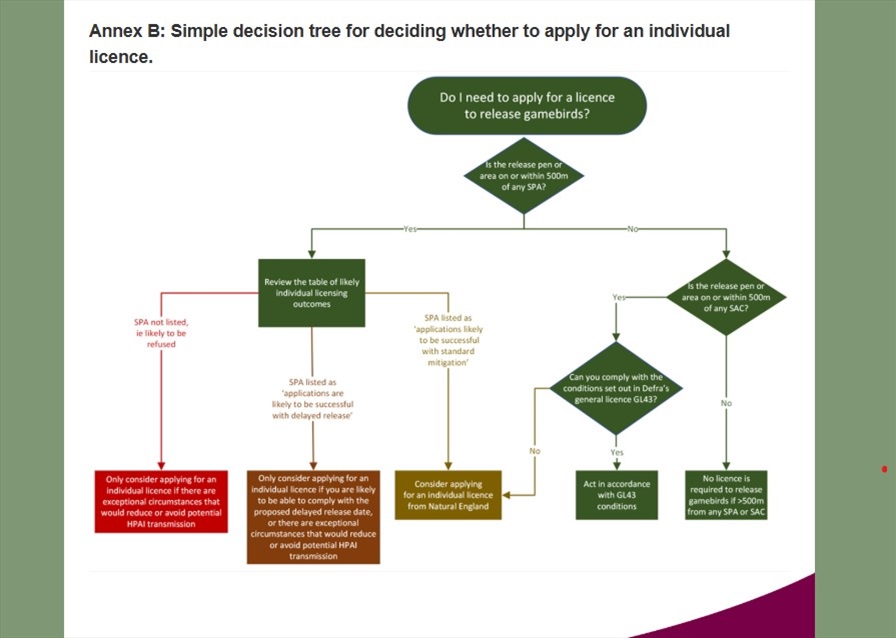
Natural England’s approach and likely licensing outcomes have been significantly influenced by the continuing avian influenza outbreak, which is currently categorised as ‘high’ or ‘very high’ risk for wild birds in Great Britain. The table below is the product of a detailed assessment undertaken by Natural England that has considered a range of potential measures for each SPA to mitigate the transmission of avian influenza between gamebirds and wild bird populations. A simple decision tree-diagram is provided at Annex B to help you decide whether or not to apply for an individual licence.
Changes to the likely licensing outcomes from 2025
Natural England has updated the lists of ‘likely licensing outcomes’ following a review of the best available evidence. A particular focus has been on the risk to overwintering woodlark populations from avian flu outbreaks. Woodlark are a breeding feature of a number of SPAs in England, but it is increasingly recognised that many woodlarks routinely overwinter on and around these SPAs. Woodlark wintering behaviour includes foraging in flocks on winter stubbles and woodland edge habitats, which will bring them into close proximity to released gamebirds, and hence direct and indirect avian flu transmission risk. Furthermore, woodlark start to establish breeding territories from February when significant numbers of gamebirds will still be present in the landscape. There are evidence gaps and uncertainties, including the susceptibility and resilience of woodlark to avian flu outbreaks.
However, Natural England’s reviews have concluded that ‘adverse effects on site integrity’ cannot be ruled out for the following sites:
-
· Breckland SPA
-
· Sandlings SPA
-
· Thames Basin Heaths SPA
-
· Thursley, Hankley and Frensham Commons (Wealden Heaths Phase 1) SPA
-
· Wealden Heaths Phase 2 SPA.
For this reason, it is unlikely that licences will be granted for these SPAs in 2026.
Highly pathogenic avian influenza has now been a significant feature for several years in England. Natural England says it recognises the difficult decisions that shoots continue to face as a result. They hope that early notification helps reduce impacts and understand that in some cases release pens and areas can be moved outside SPA buffer zones.
Natural England will look to engage proactively with stakeholder representatives to consider how research might address evidence gaps and uncertainties, and how positive conservation management activities can be maintained and supported in affected areas. Examples of key research gaps include transmission risks, and susceptibility and resilience of different gamebird and wild bird species and groups to avian influenza; as well as sustainable release densities, in order to support future decision-making including Habitats Regulations Assessments.
Natural England aims to share its sHRA and site-level assessments later in March 2026, and after that will hold a further call with sector representatives. It is recommended that you speak to sector representatives before considering any application arguing exceptional circumstances.
Licence Compliance and Unlicensed Releases
As a reminder, it is vital that you read and comply with the conditions of any wildlife licence. For gamebird release licences this includes release densities, biosecurity measures, and reporting requirements. There are separate reporting forms for GL43 and individual licences, linked from the relevant licensing pages on gov.uk.
Natural England undertakes checks on licence compliance, which are completed in liaison with Defra for GL43. These checks include reviewing reports of action and undertaking site-based inspections. Indications are that significant numbers of licensees did not submit reports of action within the required deadlines. This is an offence under the Wildlife and Countryside Act 1981 and undermines confidence and trust. If licensees are found to have breached the terms and conditions of a licence, Natural England may take enforcement action including the revocation of licences, imposition of monetary penalties or prosecution, in accordance with our enforcement position (Enforcement laws: advice on protecting the natural environment in England - GOV.UK).
In 2025, Natural England became aware of a number of gamebird releases which were alleged to have been conducted without an individual licence, and in areas or at densities not eligible to rely upon GL43. The release of gamebirds on or within 500m of a European site without a licence is an offence under section 14 of the Wildlife and Countryside Act 1981. Cases involving allegations of unlicensed releases are always referred to local police forces for further investigation and, where proven, may result in criminal sanctions.
If you are found to have breached the terms and conditions of your licence, or you receive a sanction from the police relating to an unlicensed activity, this will affect your eligibility to use other General Licences and may impact future individual licensing decisions.
Annex A: List of Likely Licensing Outcomes for Proposed Gamebird Releases on or within 500m of SPAs
SPAs where applications are likely to be successful with standard mitigation
-
· Falmouth Bay to St Austell Bay
SPAs where applications are likely to be successful with delayed release
-
· Ashdown Forest (1 September)
-
· East Devon Heaths (1 September)
-
· Great Yarmouth North Denes (1 October)
-
· Greater Wash (1 October)
-
· North York Moors (1 September)
-
· Northumberland Marine (1 October)
-
· Outer Thames Estuary (1 October)
-
· Peak District Moors (South Pennine Moors Phase 1) (1 September)
-
· Porton Down (1 October)
-
· Solent and Dorset Coast (1 October)
-
· South Pennine Moors Phase 2 (1 September)
-
· Thorne and Hatfield Moors (1 September)
Important Notes:
a. Where an SPA is not listed in the above list, Natural England is likely to refuse any licence applications for gamebird releases on that SPA.
b. The above outcomes are intended only to act as an indication as to the likely outcome of a licence application made for a particular SPA. It does not prejudge Natural England’s decision, and any application will be assessed on its merits.
c. Where a licence is issued for an SPA, the ‘delayed release’ date indicates the likely date after which gamebirds can be released (where applicable). The delayed release approach is designed to limit the interaction between gamebirds and breeding SPA birds; by ensuring releases only take place once these SPA birds have left the site. This helps to minimise the potential for significant avian influenza transmission to SPA bird populations.
d. It is recognised that delayed release dates may not be practical for all gamebird managers. Where it is not possible to adhere to a specified delayed release date, it is likely that an application will be refused
Annex B Simple Decision Tree for deciding whether to apply for an individual licence.
If any NGO member requires assistance or further information regarding your individual licence, please contact John Clarke, on john.clarke@nationalgamekeepers.org.uk.
Ends
Notes to Editors:
The National Gamekeepers’ Organisation: The National Gamekeepers’ Organisation (NGO) represents the gamekeepers of England and Wales. The NGO defends and promotes gamekeeping and gamekeepers and works to ensure high standards throughout the profession. The National Gamekeepers’ Organisation was founded in 1997 by a group of gamekeepers who felt that keepering was threatened by public misunderstanding and poor representation. Today, there are 13,000 members of the National Gamekeepers’ Organisation. www.nationalgamekeepers.org.uk
Advertisements
Help to support the NGO by visiting one of our dedicated sponsors.